記 record
キ・しるす
- 言 words
- 己 sound part
MEANING + SOUND 言 supplies words and 己 sound. 記 preserves words in writing. A 日記 records what happened that day. Learn its pronunciation にっき as a word.
Origin referenceJLPT N3 · WORDS / LANGUAGE
言 on the left is ごんべん. Think of words and language: speaking, reading and telling.
Language does more than speak: it records, explains and acknowledges.

キ・しるす
MEANING + SOUND 言 supplies words and 己 sound. 記 preserves words in writing. A 日記 records what happened that day. Learn its pronunciation にっき as a word.
Origin referenceセツ・とく
MEANING + SOUND 言 contributes words and the right side sound. 説 connects to explaining something through language. 説明 combines this with 明, making something clear.
Origin referenceダン
MEANING + SOUND 言 supplies words and 炎 sound. 談 originally referred to talking calmly, not “speaking fiercely like fire.” In 相談, people talk something over.
Origin referenceチョウ・しらべる
MEANING + SOUND 言 supplies meaning and 周 sound. 調 originally connected with being in order. Today it appears in investigating and in condition or tone. Use the radical as a clue, then check the particular word.
Origin referenceキョ・ゆるす
MEANING + SOUND 言 contributes words and 午 sound. Accepting what another person says connects to allowing or forgiving. Relationships formed through language also belong to this family.
Origin referenceニン・みとめる
MEANING + SOUND 言 supplies words and 忍 connects with the sound component. Accepting what another says leads to acknowledging it. It is not simply “enduring words.”
Origin referenceゴ・かたる
MEANING + SOUND 言 points to words; 吾 gives a GO sound clue. Hear 語 as GO in 日本語 (にほんご), Japanese.
Origin referenceワ・はなす
MEANING + SOUND 言 contributes words; the right-hand 舌 developed from the older sound component 𠯑. 話 connects to people exchanging words. Moving your tongue to speak can help memory, but distinguish that association from the historical sound role.
Origin referenceドク・よむ
MEANING + SOUND 言 points to language. The right side simplifies an older sound component; it does not mean “sell words.” Reading draws meaning from written words and can give them a voice.
Origin referenceゲン・ゴン・いう
ORIGIN 言 is explained as a mouth with a tongue extending from it. Its family includes spoken language and written words. On the left, 言 is called ごんべん.
Origin referenceケイ・はかる
ORIGIN 言 contributes spoken words and 十 a complete set of numbers. Counting aloud connects to measuring. Both parts carry meaning. A 時計 measures time; learn its reading とけい as a whole word.
Origin referenceシ・ためす
MEANING + SOUND 言 identifies the language family; 式 supplies a sound clue. The dictionary connects an earlier use, appointing someone to an office, with testing. Today 試 appears in trying something and taking a test.
Origin reference言 suggests speaking, writing or communicating. But 炎 in 談 supplies sound. Distinguishing meaning + meaning from meaning + sound keeps your learning accurate.
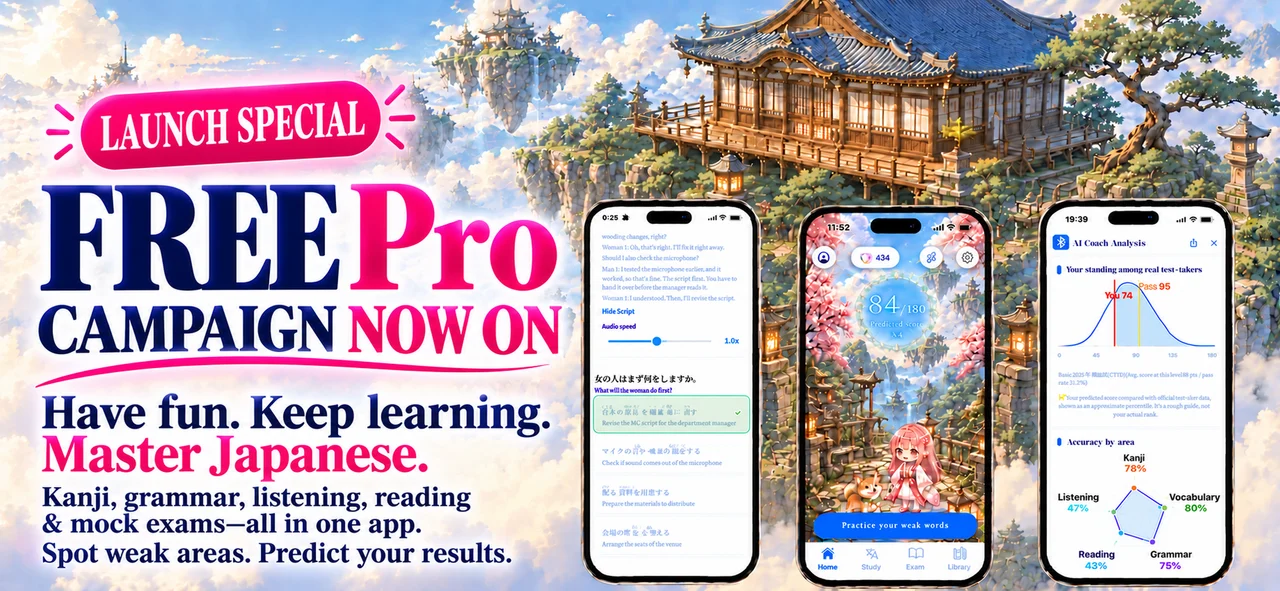
Launch special
Study kanji, vocabulary, grammar, listening, reading and mock exams in one app. Use Pro features for free during the campaign.
Available worldwide except Nepal. Regions and campaign details may change. Check the app for current availability.