客 guest
キャク・カク
- 宀 roof
- 各 KAKU
MEANING + SOUND Remember the meaning by imagining a guest welcomed under a roof. 各 gives a KAKU sound clue. 客 is also read KYAKU, so check the word audio.
Origin referenceJLPT N3 · ROOF / HOME
宀 suggests a roof. It gives a clue about houses or places inside them.
Under a roof: a person and a sleeping mat. 宿 holds a small scene of staying the night.

キャク・カク
MEANING + SOUND Remember the meaning by imagining a guest welcomed under a roof. 各 gives a KAKU sound clue. 客 is also read KYAKU, so check the word audio.
Origin referenceシュク・やど
ORIGIN 宀 is the house and 亻 is a person. The part that now looks like 百 originally depicted a mat. A person lying on a mat inside a house gives the scene of staying overnight. The character is not about a hundred guests.
Origin referenceシュ・まもる
ORIGIN 宀 is a house and 寸 is connected with a right hand. Managing affairs inside a house connects to guarding or protecting. The roof and hand both contribute meaning.
Origin referenceカン
MEANING + SOUND 宀 is the meaning component and 元 the sound component. 完 means having nothing missing. 完成 is completion: something being made is finished. A concrete radical can also appear in an abstract idea.
Origin referenceカン
ORIGIN 宀 is a house; the inner shape connects with a group of people. People inside a building led to the sense of an official. Compare 館 and 管, where 官 instead serves as a sound component.
Origin referenceジツ・み・みのる
ORIGIN The older form 實 contains 宀, a house, and 貫, associated with valuables. Being filled with things connects to ripening and fruit. The inside is simplified in today's 実.
Origin referenceカ・ケ・いえ
ORIGIN 宀 represents a building and 豕 a pig. Kanjipedia explains the combination as a building where offerings were made to ancestors, later extending to a home. The character preserves a connection between ancient buildings and rituals.
Origin referenceジ
ORIGIN 宀 is a house and 子 a child: raising a child inside a home. The dictionary connects 字 as a written character with compound characters growing from simpler forms, like children.
Origin referenceアン・やすい
ORIGIN The character combines a roof, 宀, and 女. The dictionary connects being settled inside a home with being at peace. 安心 means peace of mind; 安 also appears in 安い, inexpensive.
Origin referenceシツ
MEANING + SOUND 宀 is a house. 至 contributes sound and the idea of reaching. The connection is to an inner room reached within a house. 教室 then names a room for teaching.
Origin reference宿 is やど by itself but SHUKU in 宿題. Use the radical to find a meaning family, then collect readings through real words.
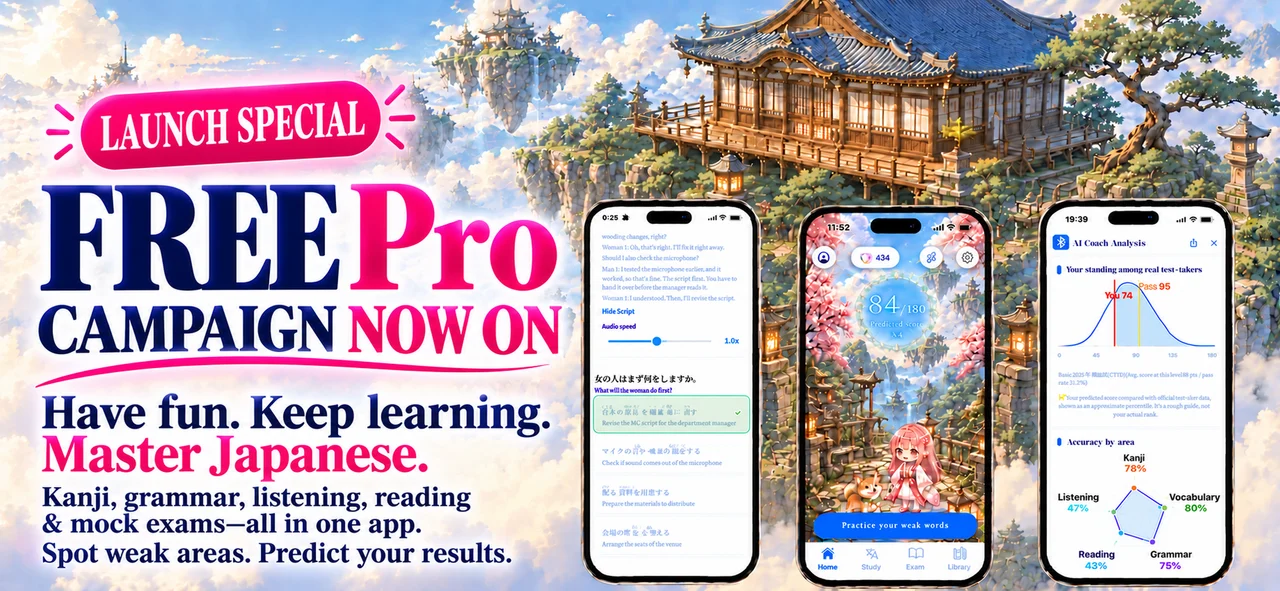
Launch special
Study kanji, vocabulary, grammar, listening, reading and mock exams in one app. Use Pro features for free during the campaign.
Available worldwide except Nepal. Regions and campaign details may change. Check the app for current availability.