
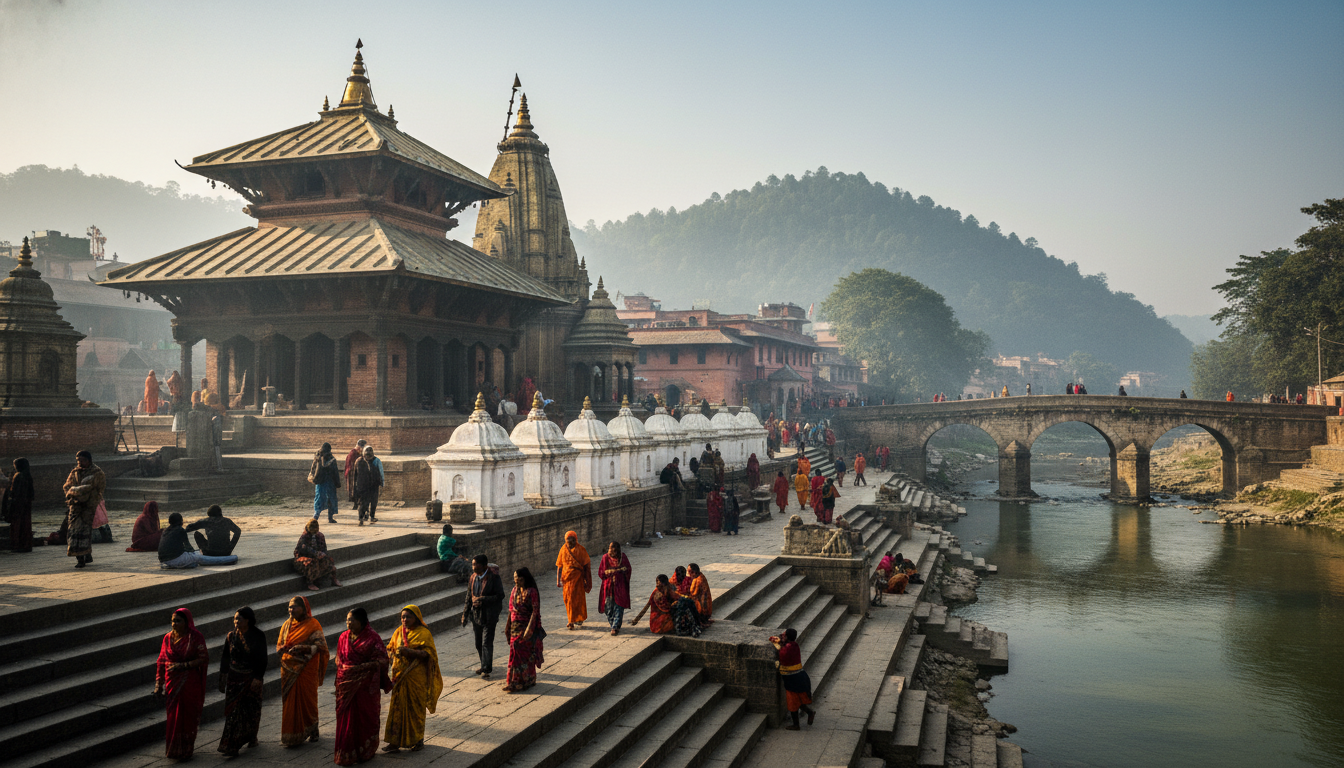
Pashupatinath (पशुपतिनाथ) is Nepal’s most sacred Hindu site ─ a sprawling temple complex on the banks of the Bagmati River dedicated to Shiva. It is a place of prayer, pilgrimage, and cremation; a place where life and death sit quietly side by side.
If Boudhanath holds the stillness of prayer, Pashupatinath holds the whole arc of a human life. This guide is meant for visitors who want to come here with respect.
📌 Before you go: The inner sanctum is open only to Hindus. Non-Hindu visitors can still walk the wider grounds, sit on the east bank, and watch the river and aarti from across the water. This guide is written from that outside-visitor perspective.
What is Pashupatinath?
Pashupatinath lies about 5 km east of central Kathmandu, very close to the international airport. It spans both banks of the Bagmati River and was inscribed as part of the UNESCO World Heritage Site of the Kathmandu Valley in 1979.
Quick facts
| Item | Detail |
|---|---|
| Location | ~5 km east of central Kathmandu (near the airport) |
| Deity | Shiva (= Pashupati, “Lord of All Living Beings”) |
| Religion | Hinduism |
| UNESCO listing | 1979 (as part of Kathmandu Valley) |
| History | Ancient origins (multiple traditions); current main shrine said to be a 17th-century rebuild (sources vary) |
| Entry fee | NPR 1,000 for foreigners (~USD 7 ・ approx. 2026); free for Nepali and Indian citizens |
| Hours | Roughly 4:00 – 21:00 (the main shrine closes for parts of midday ─ check before going) |
| Inner sanctum | Hindus only; the outer grounds, ghats and east bank are open to everyone |
About the name “Pashupati”
Pashupati is one of Shiva’s names ─ it means “Lord of All Living Beings.” People, animals, life, death ─ Pashupati watches over all of it.
Why come to Pashupatinath?
🛕 A living center of Hindu devotion
Pilgrims come not only from Nepal but from across India. Bells, mantras, the scent of incense and butter lamps ─ devotion here isn’t a performance; it’s daily life.
🔥 Where life and death sit side by side
Along the river, traditional Hindu cremations take place at the ghats every day. They are not a tourist sight. They are the most important moment in a family’s life. You can watch quietly from the east bank, at a respectful distance (please read the etiquette below carefully).
🧘 Encounters with sadhus
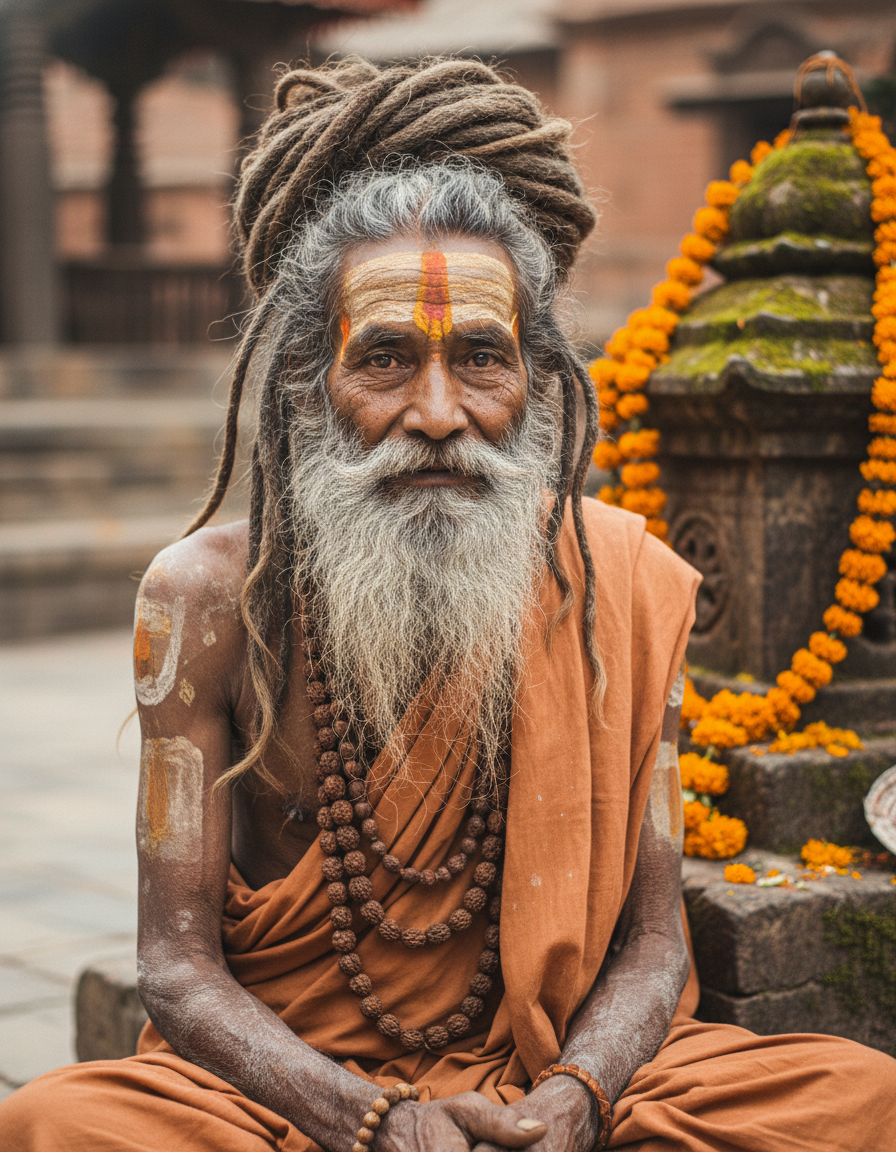
Around the grounds you’ll meet sadhus (Hindu ascetics) ─ figures painted with tilakas, dusted in ash, who have dedicated their lives to Shiva. Photographing them follows its own quiet etiquette (more below).
When to go
🌅 Morning (early to mid-morning)
- Pilgrims come for prayer; far fewer tourists
- Morning light over the riverside shrines
- Quiet walking through the grounds
- Cooler temperatures, lighter crowds
🌆 Evening ─ Bagmati Aarti
The day’s highlight is the Bagmati Aarti (riverside fire ceremony) held in the evening. Priests raise large flaming lamps, mantras and bells echo across the water. Non-Hindu visitors are welcome to watch.
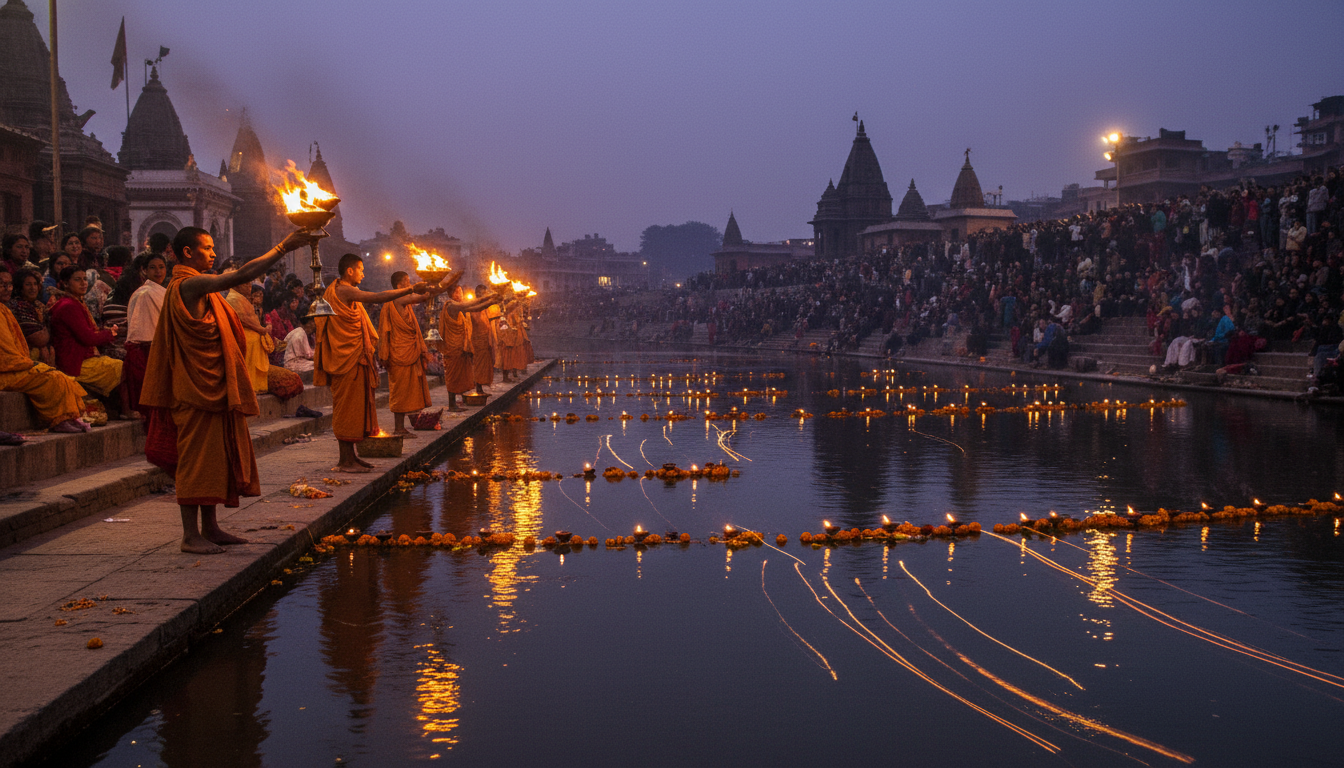
- Starts around 18:00 as a rough guide (varies by season ─ confirm locally)
- Sit on the east bank steps for the best view
- Arrive ~30 minutes early to find a good spot
→ The best plan is to come both in the morning and the evening. The riverside transforms completely between the two.
Getting there
From Thamel (tourist district)
| Mode | Travel time | Cost (approx. 2026) |
|---|---|---|
| Taxi | ~20–30 min | NPR 500–700 (~USD 4–5) |
| Pathao / inDrive (ride-share) | ~20–30 min | Often cheaper than a taxi |
| Local bus | 1 hr+ | ~NPR 30 (crowded, hard to navigate) |
⏰ Avoid rush hour
Traffic is heaviest between 9:00–11:00 and 17:00–19:00. If you’re aiming for the evening aarti, leave with plenty of buffer time ─ Kathmandu traffic can swallow an hour without warning.
6 things to do at Pashupatinath
1. 🏞️ Watch the whole scene from the east bank
For non-Hindu visitors, the east bank terrace is the front-row seat. Stone steps face the main shrine, the ghats, and the river ─ everything in one frame. Morning brings soft light; evening brings the aarti.
2. 🪔 Watch the Bagmati Aarti
Anyone can watch the evening fire ceremony (see above). The mix of flames, chanting, bells, and floating butter lamps stays with you.
3. 🧘 Photograph a sadhu (with the right etiquette)
Sadhus often agree to be photographed, but expect a small offering in return. To avoid awkward moments:
- Always ask first: “Photo OK?”
- Agree on the amount before taking the photo (NPR 100–200 is a reasonable starting point as of 2026)
- If someone insists on a large amount (NPR 500+), it’s fine to politely decline
- Thank them warmly after
4. 🚶 Walk the line of riverside shrines (shivalaya)
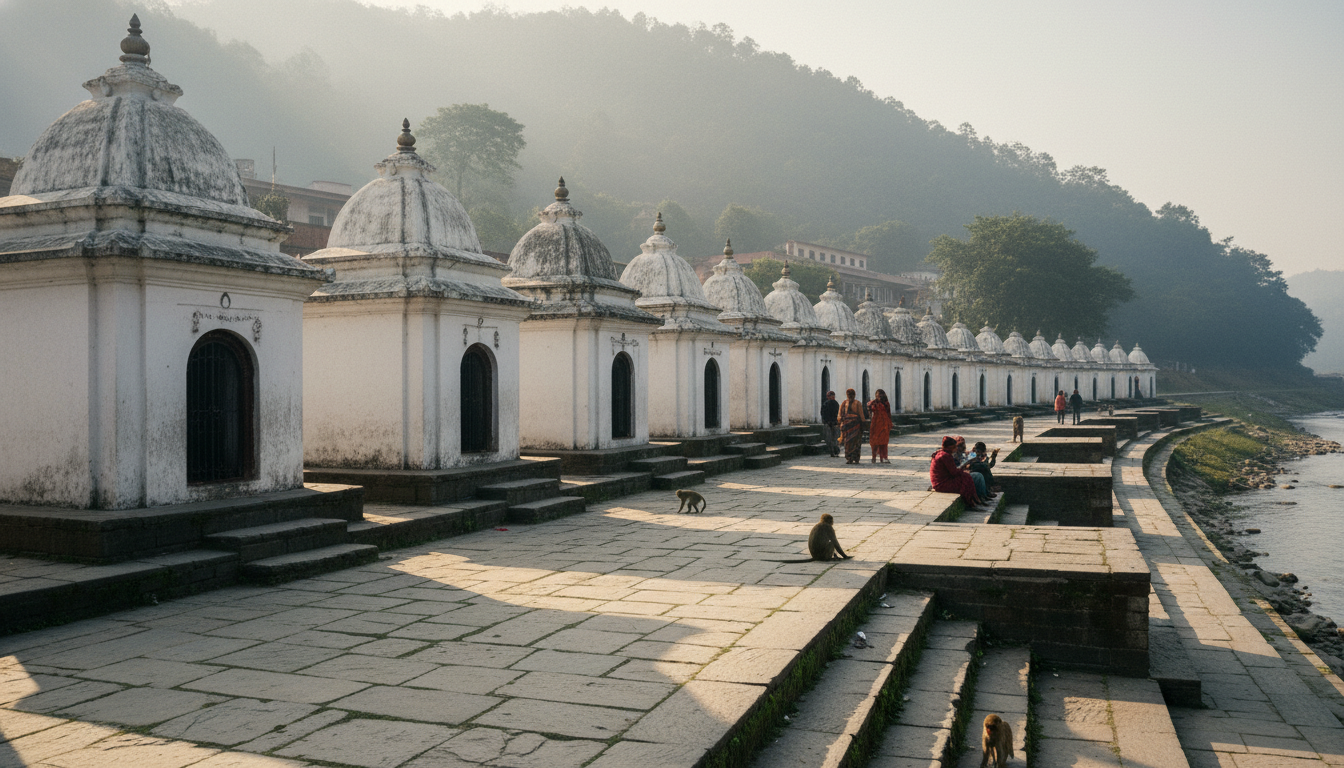
On the east bank, a quiet row of small white stone shrines (shivalaya) lines the river. Each one houses Shiva; walking past them in silence is its own kind of meditation.
5. 🐒 The forest behind the temple (Mrigasthali)
Behind the main complex, a forest rises with a healthy monkey population.
- Do not carry visible food; monkeys are quick
- Keep your bag zipped; expect curious paws
6. 🙏 Bear witness, quietly, to the cremations
The ghats are where families perform the last rites of a life. This is not “sightseeing.” From the east bank, with respect, you simply bear witness. Please read the next section carefully.
At the cremation ghats ─ the most important thing
Many visitors to Pashupatinath find themselves face to face with a cremation in progress. It is not a “sight.” It is a moment in someone’s life being released.
Stay distant, on the far bank. Do not photograph cremations ─ it is explicitly forbidden, and beyond rules, it is a question of respect for grieving families.
Lower your voice, just be present. Many travelers describe Pashupatinath as a place that stays with you for life ─ this is why.
Cultural etiquette
| ✅ Do | ❌ Don’t |
|---|---|
| View the main shrine from the outside | Try to enter the inner sanctum if you’re not Hindu |
| Watch cremations only from the far bank, quietly | Photograph or film cremations |
| Cover shoulders and knees | Sleeveless tops or shorts |
| Avoid leather items (belts, bags) in sacred areas | Walk in with leather on |
| Confirm consent and price before photographing sadhus | Take photos without asking, or argue over money after |
| Keep your voice low | Loud talking, laughter, selfie-stick energy |
The two most important rules: don’t photograph cremations, and keep the space quiet.
🪔 The biggest festival: Maha Shivaratri Held in February–March (the date moves each year by the Hindu calendar ─ check locally). Hundreds of thousands of pilgrims and many sadhus gather from all over Nepal and India. The grounds become incredibly crowded ─ if you visit, plan for early morning, bring water, and keep your plans flexible.
Useful Nepali phrases for travelers
Simple Nepali phrases that come in handy at Pashupatinath.
| English | Nepali | Pronunciation |
|---|---|---|
| Hello / Goodbye | नमस्ते | Namaste |
| Thank you | धन्यवाद | Dhanyabad |
| Can I take a photo? | फोटो खिच्न मिल्छ? | Photo khichna milcha? |
| How much? | कति पर्छ? | Kati parcha? |
| Where is the entrance? | प्रवेशद्वार कहाँ छ? | Prabesh-dwar kahan cha? |
| No, thank you | पर्दैन | Pardaina |
| Quietly, please | बिस्तारै | Bistarai |
A single word of Nepali, even just namaste, softens the room ─ try it.
A place that holds the whole arc of a life
Golden roofs, the riverside fire of the aarti, ash-covered sadhus, families saying goodbye. Pashupatinath isn’t always a “fun” place to visit. But the way this place quietly holds an entire human life stays with you long after Nepal.
Come with respect, with quiet. Try both the morning light and the evening aarti.
🗣️ Before you go ─ learn a few Nepali greetings
A single “नमस्ते (Namaste)” changes how locals welcome you.
We’re building Listen & Speak Nepali ─ a Nepali-learning app where you can pick up practical phrases like the ones in this article, with native audio on every example.
- 💎 100% free ─ no in-app purchases, no premium tier
- 🎧 1,800 conversations + 600 grammar + 1,000 words ─ all with native audio
- ✈️ Fully offline ─ works without signal in the hills
- 🚫 No ads, no tracking, no account required
- 📱 iOS available on the App Store ・ Android in open β (testers welcome!)
Questions, feedback, or requests for the next destination to cover ─ reach us at [email protected].
Back to blog