
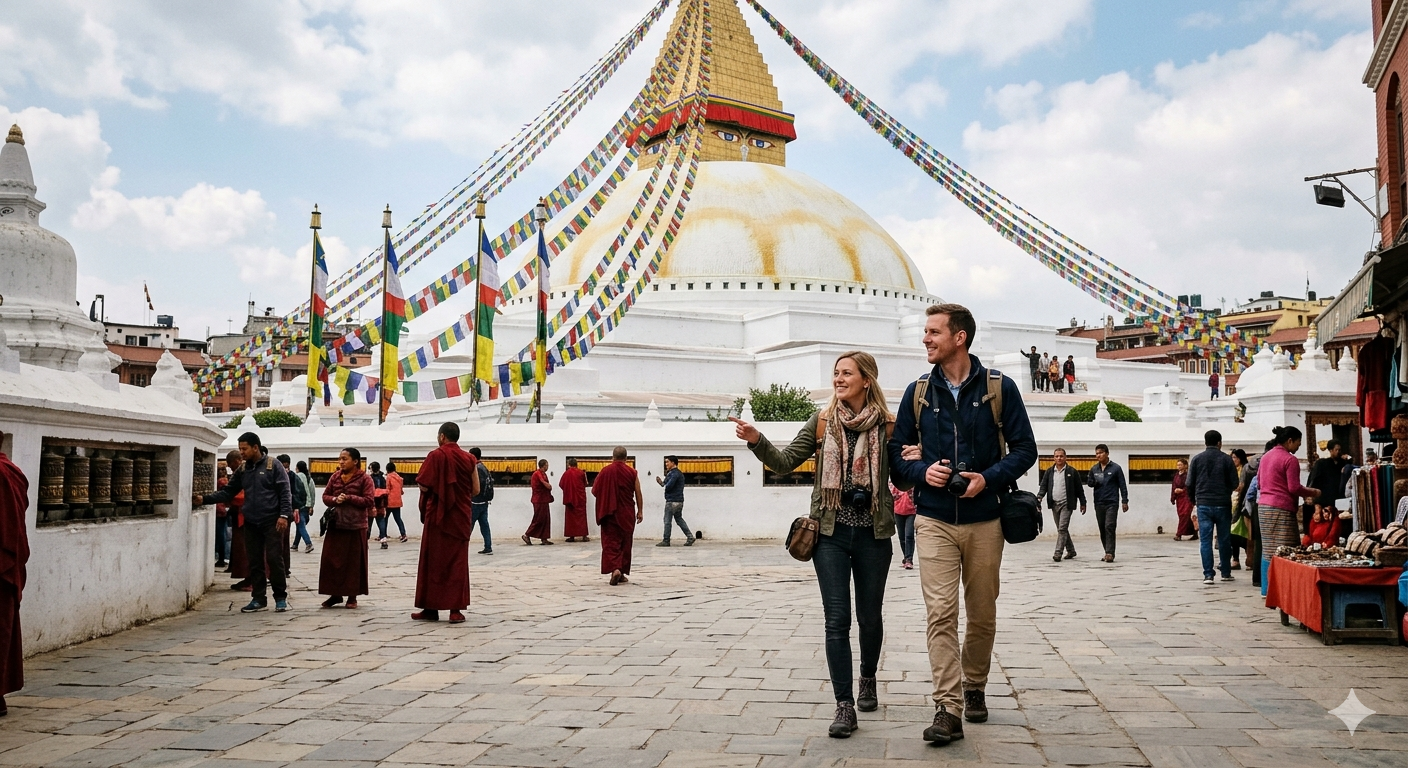
Boudhanath (Bouddha / बौद्धनाथ) is one of those rare places where a major tourist site is still, first and foremost, a place of devotion. A massive white stupa anchors a neighborhood filled with monasteries, butter lamps, prayer wheels, and the soft murmur of mantras.
This guide is meant to help you experience Boudhanath ─ not just see it.
What is Boudhanath?
Boudhanath is a giant Buddhist stupa located about 6 km northeast of central Kathmandu. It was inscribed as a UNESCO World Heritage Site in 1979.
Quick facts
| Item | Detail |
|---|---|
| Location | ~6 km northeast of central Kathmandu |
| Height | ~36 m (varies by source) ・ base diameter ~100 m |
| Built | Estimated 5th–7th century (multiple traditions) |
| Religion | Tibetan Buddhism (Vajrayana) |
| UNESCO listing | 1979 |
| Entry fee | NPR 400 for foreigners (~USD 3 ・ approximate as of 2026) |
| Hours | Open all day (butter lamps at night are magical) |
The eyes on the spire
The painted blue eyes that look out in four directions are the Wisdom Eyes of the Buddha. The single curling mark between them ─ which looks like a question mark or a Sanskrit “1” ─ is read as the Nepali numeral “one”, traditionally interpreted as “there is only one path to enlightenment.”
Why come to Boudhanath?
🛕 Scale that grounds you
The stupa is one of the largest in the world. Walking up to it for the first time, the white dome feels almost weightless against the Kathmandu sky.
🙏 A living center of Tibetan culture
Since the 1950s, Boudhanath has been a hub for Tibetan refugees in Nepal. Around 50 monasteries line the surrounding streets, and the rhythm of monastic life is everywhere ─ red robes, butter tea, the low rumble of chanting.
🕯️ The hour of prayer
Locals walk clockwise around the stupa (a practice called kora) as a form of meditation. At dusk, hundreds of butter lamps are lit. It’s one of the most quietly powerful moments in all of Kathmandu.
When to go
You can visit at any time, but two windows stand out.
🌅 Morning (6:00 – 8:00)
- Locals begin their morning kora
- Soft light against the white dome
- Fewer tourists, easy to find calm
- Most rooftop cafés serve breakfast by 7:00
🌆 Evening (17:00 – 19:00)
- Butter lamps (दियो / diyo) are lit one by one
- Low chanting drifts from the monasteries
- The clearest sense of “this is a place of prayer”
- Perfect lighting for photos
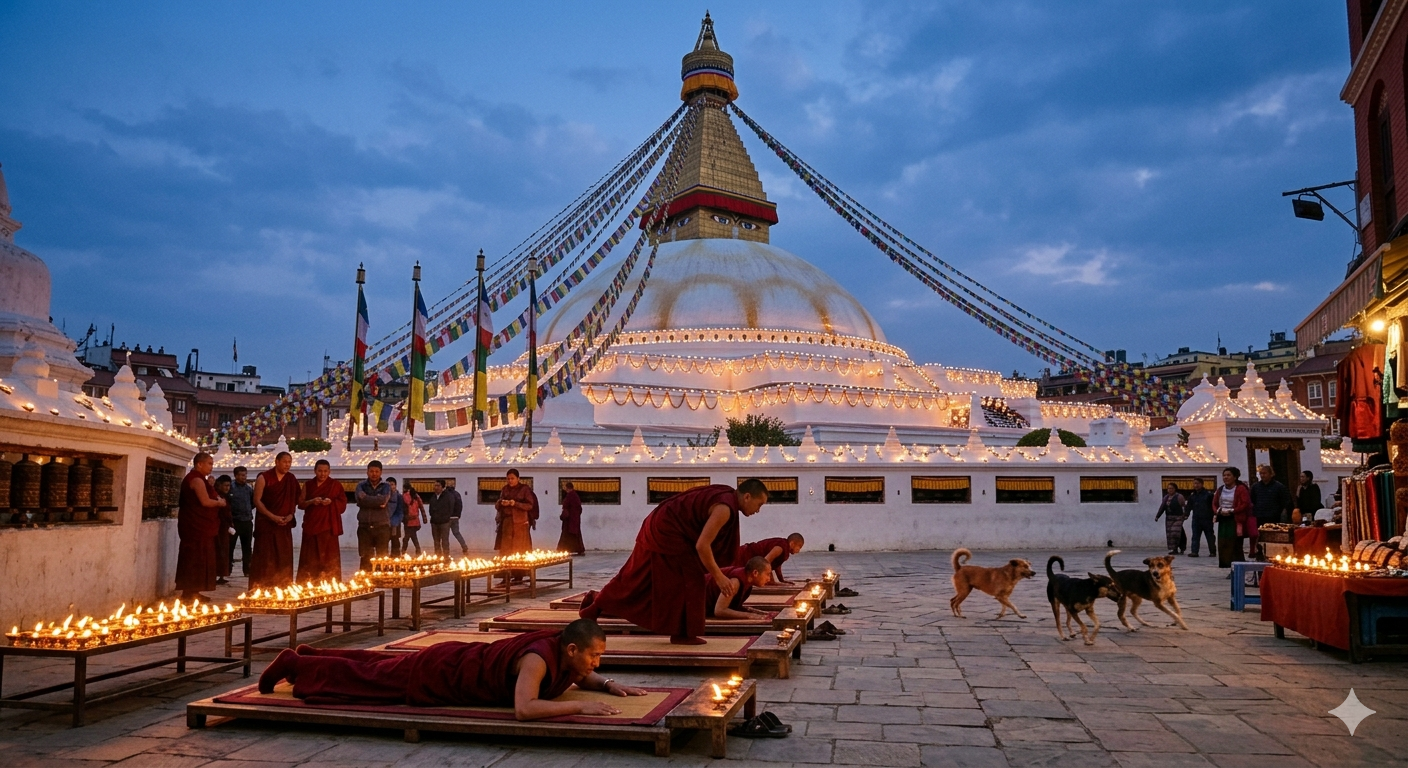
🙏 Witnessing the full prostration
In the evening, you may see pilgrims and monks performing full prostrations (panchang) ─ a deeply devotional Buddhist practice where the worshipper touches five points (both knees, both elbows, and the forehead) to the ground.
Many do this hundreds or thousands of times, slowly working their way around the stupa on padded boards. It is a form of praying with the body.
Watch from a respectful distance. If you want to take a photo, ask first.
➡️ The best plan is to visit both morning and evening ─ the place transforms.
Getting there
From Thamel (tourist district)
| Mode | Travel time | Cost (approx. 2026) |
|---|---|---|
| Taxi | ~30 min | NPR 500–700 (~USD 4–5) |
| Pathao / inDrive (ride-share) | ~30 min | Often cheaper than taxi |
| Local bus | 1 hr+ | ~NPR 30 (crowded, hard to navigate) |
⏰ Avoid rush hour
Traffic is heavy on weekdays between 9:00–11:00 and 17:00–19:00. Early mornings and early afternoons are the smoothest times to travel.
6 things to do at Boudhanath
1. 🚶♀️ Walk the kora
Walking clockwise around the stupa is the traditional way to receive its blessing.
- One loop: about 5 minutes
- At dawn and dusk you’ll walk alongside locals
- Spin the prayer wheels (mani chakra) as you pass
2. 🕯️ Light a butter lamp
- Lamp houses are set up along the kora path
- About NPR 50–100 per lamp (approx. 2026)
- Light it quietly and make a wish
3. ☕ A rooftop café with a stupa view
The cafés around the stupa offer stunning rooftop views ─ many have “rooftop” or “stupa view” in their names.
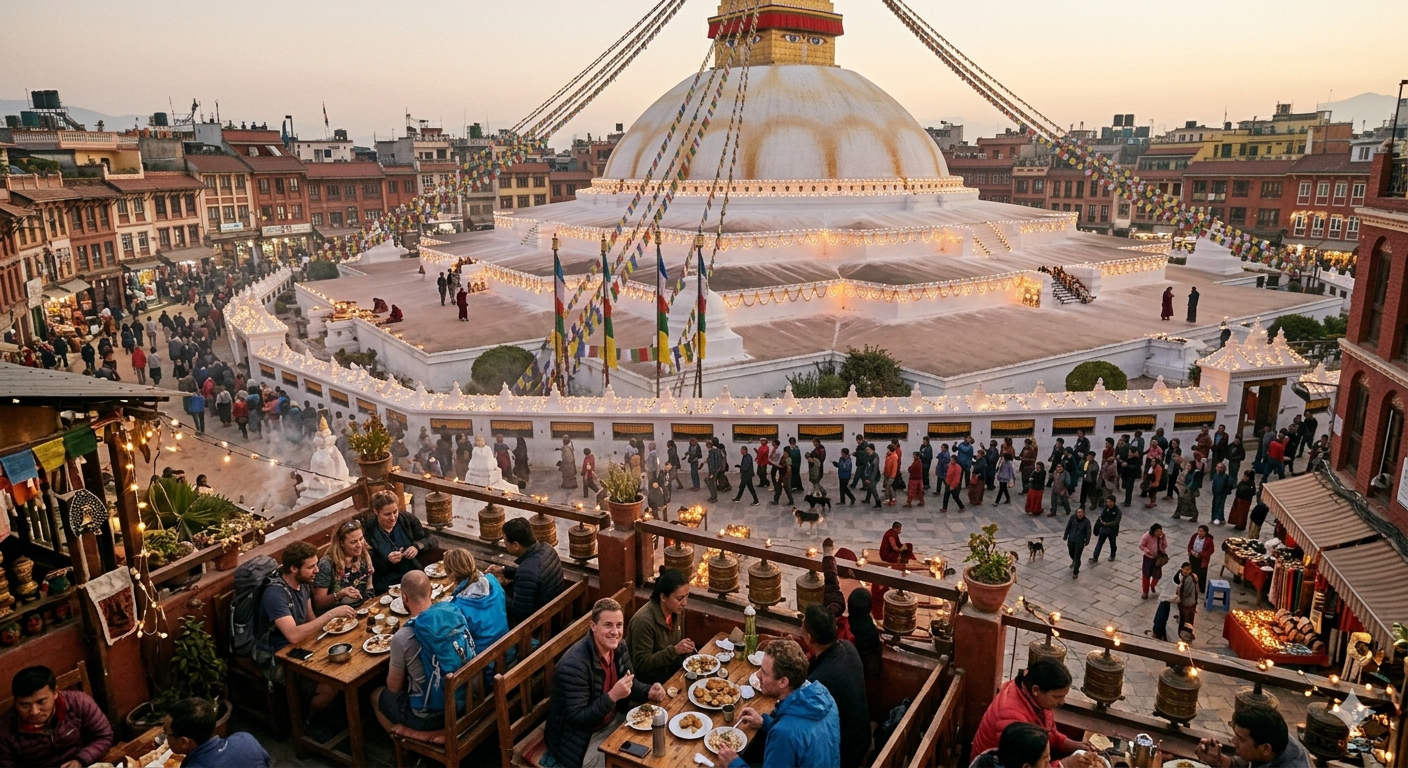
Search “Boudhanath rooftop cafe” in Google Maps for a list. Check reviews and photos for the atmosphere you prefer.
Going in the evening means you’ll catch the butter lamp lighting from above ─ coffee in hand, watching prayer below. One of the most quietly luxurious experiences in Kathmandu.
4. 🛕 Visit a monastery (gompa)
There are 50+ monasteries in the neighborhood, and many welcome visitors for free. The murals and thangka paintings inside are extraordinary.
- Enter quietly
- If chanting is in progress, listen ─ don’t talk
5. 🛍️ Shopping for Tibetan crafts
Boudhanath is a great place for:
- Thangka (Tibetan Buddhist paintings)
- Mala (prayer beads)
- Incense and incense holders
- Tibetan silver jewelry
- Yak cheese and candy
6. 📷 Photo spots
- The Wisdom Eyes are clearest from the south side of the square
- Morning light makes the eyes pop
- Evening combines stupa, monks, and butter lamps in one frame
🍜 The Tibetan flavors of Boudhanath
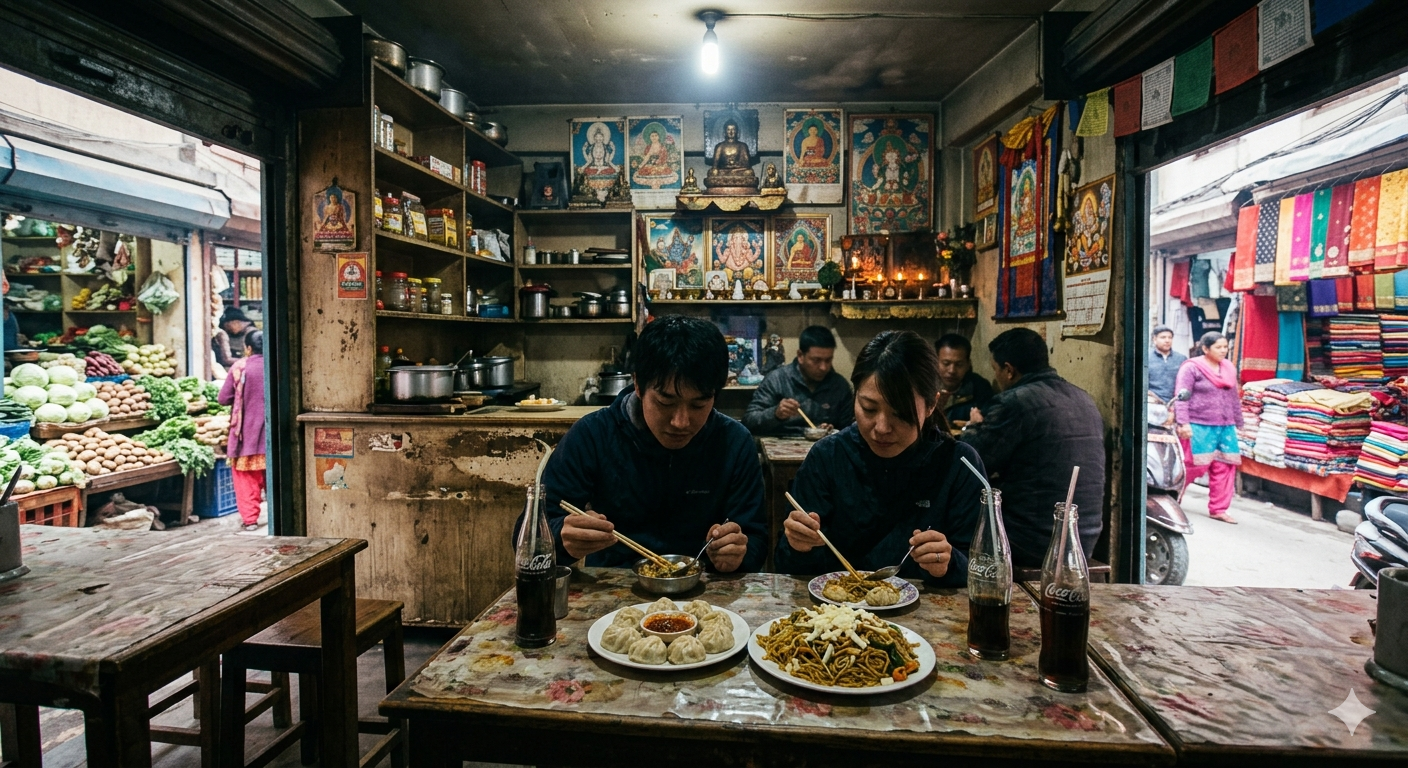
Boudhanath is the center of the Tibetan Buddhist community in Kathmandu. What you really want to try here isn’t the food you’ll find all over Nepal ─ it’s the distinctly Tibetan dishes that this neighborhood does especially well. Head into the side alleys to find them.
Pick #1: Po Cha — Tibetan butter tea (पो चा)
A warm drink made from yak butter, salt, and tea leaves ─ a Himalayan classic. Surprising at first taste: more like a savory butter broth than a sweet tea.
| Item | Detail |
|---|---|
| Flavor | Salty, rich, warming |
| Price | NPR 30–60 (approx. 2026) |
| Where | Tibetan eateries and tea shops around Boudhanath |
Different from the sweet milk tea (chiya) found everywhere in Nepal. This is one you really only find in Boudhanath’s Tibetan corners.
Pick #2: Thukpa (थुक्पा)
A Tibetan noodle soup packed with vegetables and gentle spice. Built to warm up a body chilled by high altitudes.
| Item | Detail |
|---|---|
| Filling | Vegetable / chicken / buff |
| Flavor | Soothing broth, lightly seasoned |
| Price | NPR 200–350 (approx. 2026) |
| Portion | Plenty for a meal |
Best on a chilly morning, or after evening kora ─ it sinks in.
Useful Nepali for ordering
| English | Nepali | Pronunciation |
|---|---|---|
| One po cha, please | एक पो चा दिनुस् | Ek po cha dinus |
| One plate of thukpa, please | एक प्लेट थुक्पा दिनुस् | Ek plate thukpa dinus |
| Hot, please | तातो | Tāto |
| Less spicy | पिरो कम | Piro kam |
| The bill, please | बिल दिनुस् | Bil dinus |
How to pick a good spot
- Head into the side alleys, not the main square
- Thangka paintings on the wall = Tibetan-style place, usually a good sign
- Look for the line: cleanliness + popularity
- Rooftop cafés: NPR 500–1,000 (atmosphere included ・ approx. 2026)
- Local diners: NPR 200–400 for a full meal (approx. 2026)
➡️ After one loop of the kora, a cup of po cha at a small Tibetan place ─ that’s the flavor of Boudhanath in a single sip.
Cultural etiquette
| ✅ Do | ❌ Don’t |
|---|---|
| Walk clockwise | Walk counter-clockwise |
| Cover shoulders and knees | Sleeveless or shorts |
| Ask “Photo OK?” before taking | Photograph people mid-prayer without consent |
| Take off shoes inside monasteries | Walk in with shoes |
| Keep feet pointed away from the stupa | Sit with feet toward the stupa |
In Buddhist culture broadly, never point the soles of your feet at the stupa or at a monk.
Useful Nepali phrases for travelers
| English | Nepali | Pronunciation |
|---|---|---|
| Hello / Goodbye | नमस्ते | Namaste |
| Thank you | धन्यवाद | Dhanyabad |
| How much? | कति पर्छ? | Kati parcha? |
| Can I take a photo? | फोटो खिच्न मिल्छ? | Photo khichna milcha? |
| Where is Boudhanath? | बौद्ध कहाँ छ? | Bauddha kahan cha? |
| Make it cheaper, please | सस्तो गर्नुहोस् | Sasto garnuhos |
| How are you? | सञ्चै हुनुहुन्छ? | Sanchai hununcha? |
A single word of Nepali shifts how locals respond to you ─ try it.
A place that gives you the hour of prayer
Kathmandu is busy, dusty, loud. Boudhanath is its quiet center. The footsteps walking the kora, the soft glow of butter lamps, the chanting from a monastery upstairs ─ a day here stays with you.
If you can, come twice ─ once at sunrise, once at dusk. The same place will feel completely different.
🗣️ Before you go ─ learn a few Nepali greetings
A single “नमस्ते (Namaste)” changes how locals welcome you.
We’re building Listen & Speak Nepali ─ a Nepali-learning app where you can pick up practical phrases like the ones used in this article, with native audio on every example.
- 💎 100% free ─ no in-app purchases, no premium tier
- 🎧 1,800 conversations + 600 grammar + 1,000 words ─ all with native audio
- ✈️ Fully offline ─ works without signal in the hills
- 🚫 No ads, no tracking, no account required
- 📱 iOS available on the App Store ・ Android in open β (testers welcome!)
Questions, feedback, or requests for the next destination to cover ─ reach us at [email protected].
Back to blog